Performance
Batch over scalar
The batch entry points (treeweave_batch / treeweave_sorted /
treeweave_transposed in C; calling the fitted object with an array in the
bindings) amortize leaf lookup and vectorize the polynomial evaluation across
points. Prefer them to a scalar loop for anything beyond a handful of points.
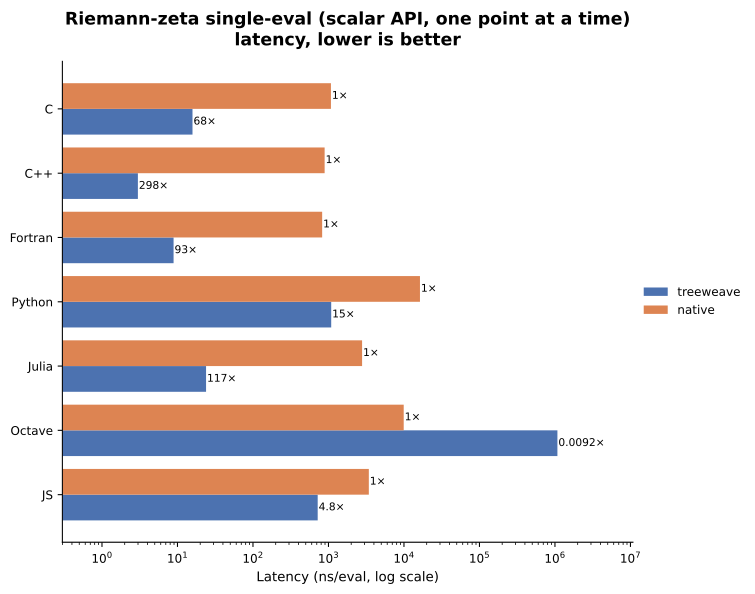
This matters most in MATLAB/Octave, where single-point eval carries an extra per-call overhead from the mwrap binding layer, not from treeweave; see Known issues. The batch path amortises that overhead to ~zero.
The sorted fast path
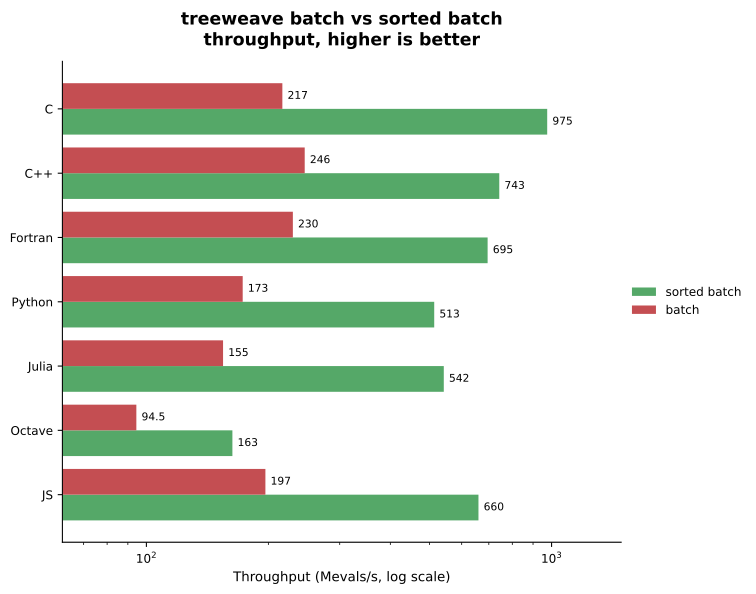
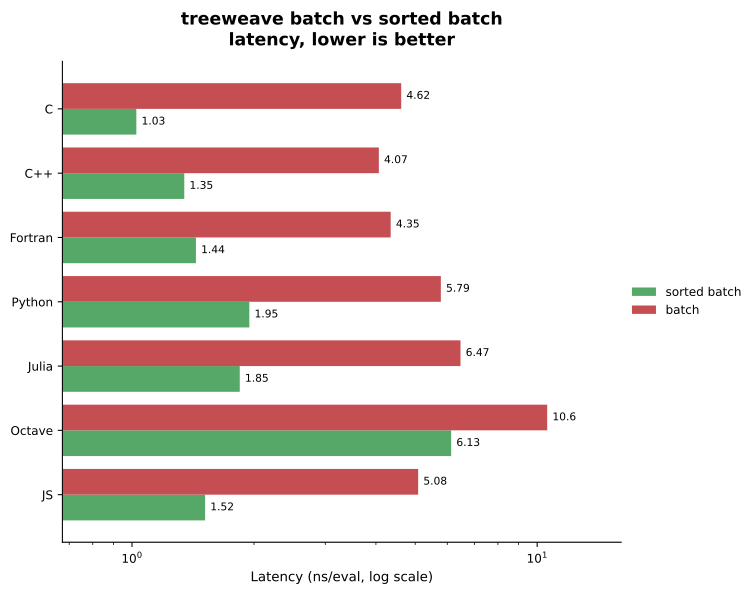
The general batch path first bin-sorts the inputs by leaf so each leaf’s
points are contiguous, runs one vectorized Horner stream per leaf, then permutes
the results back to the caller’s order. When the inputs are already ascending,
that sort and permute-back are pure overhead. The sorted path skips both and
streams straight through the leaves, ~3-4x faster on a presorted 1-D batch.
Common cases where inputs are ascending for free: regular grids, linspace,
quadrature nodes, time series, and parameter sweeps.
The caller promises x[i] <= x[i+1]; treeweave does not verify the promise, so
unsorted input yields wrong values. Use the plain batch path when the order is
unknown. It sorts internally and is always correct. Both paths NaN-fill
out-of-domain points.
The leaf-table fast path
PolyTree::find_leaf_id has a SIMD-quantize + table-lookup fast path: one
vcvttpd2qq (or scalar vcvttsd2si) per point plus one uint32_t load
from a 2^(input_dim * D)-entry table, in place of recursive tree descent.
treeweave builds the table when the leaf index needs at most 16 bits
(input_dim * D <= 16) and the tree refined uniformly to depth D.
For smooth functions, tolerance-based refinement stops early and the tree never
reaches uniform depth, so the fast path stays off. To turn it on, tighten
tol until refinement is uniform, or set min_uniform_depth explicitly.
Function::print_stats() reports Leaf table: live (N entries, K KiB) or
Leaf table: descent-only. Table memory grows as 2^(input_dim * D) * 4 B,
capped at ~256 KiB; past that treeweave skips the table.
Memory and degree
Tightening
tol, raisingmax_depth/max_memory_mib, or enablingallow_max_depth_leavesall increase the leaf count and therefore memory.The default leaf degree is 6 coefficients per axis in 1D and 7 in 2D and 3D. A 1D single-point evaluation is then 6 FMAs: 5 Horner steps and 1 for the domain map. A sweep of degrees 4 to 16 on x86-64-v3, x86-64-v4 and Apple M2 found the same fastest degree on each ISA: 5 in 1D, 5 in 2D and 6 in 3D. Those degrees use more memory, and in 2D and 3D more than the auto budget at tight
tol. The defaults trade some speed for memory. Override it (C++fit<N>) only with measurements in hand.Oscillatory or rapidly-varying functions can use a lot of memory. Fit one period of a periodic function.
Multi-threading
A fitted object is immutable. Chunk the inputs and call the eval path from multiple threads, one disjoint output slice each. treeweave never parallelizes internally, which is what makes that contract safe.
Cross-language throughput and latency
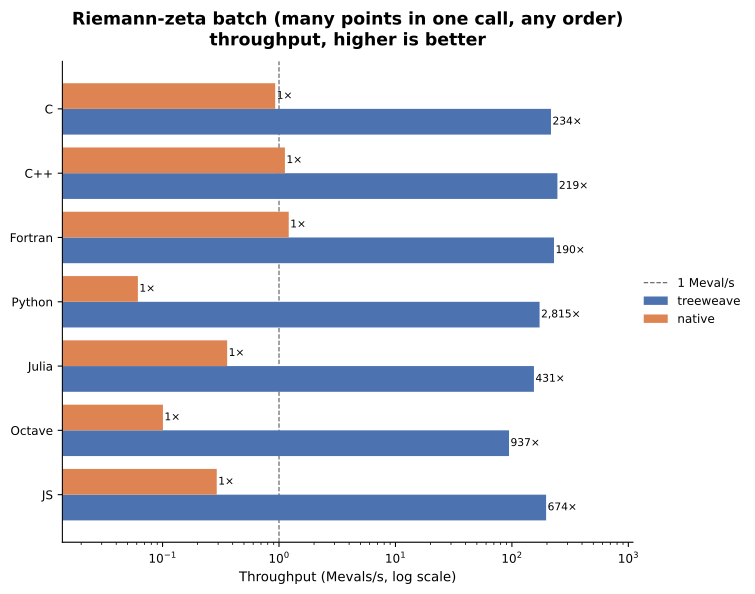
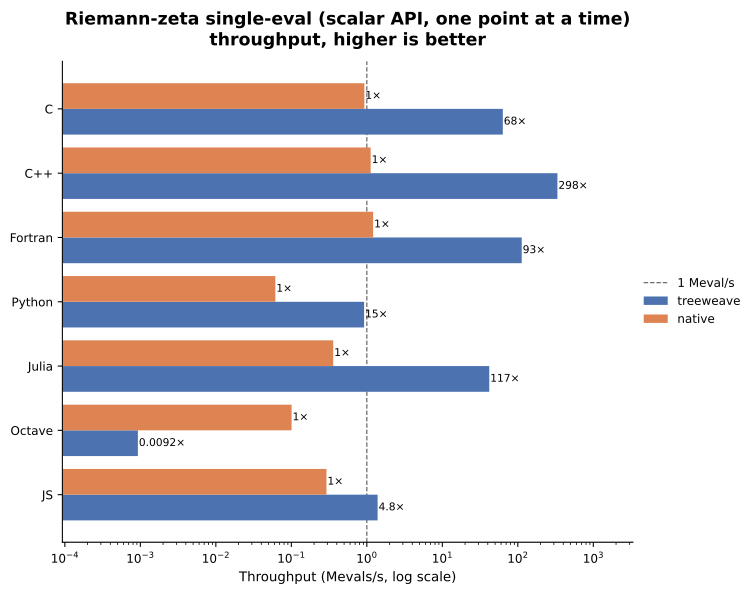
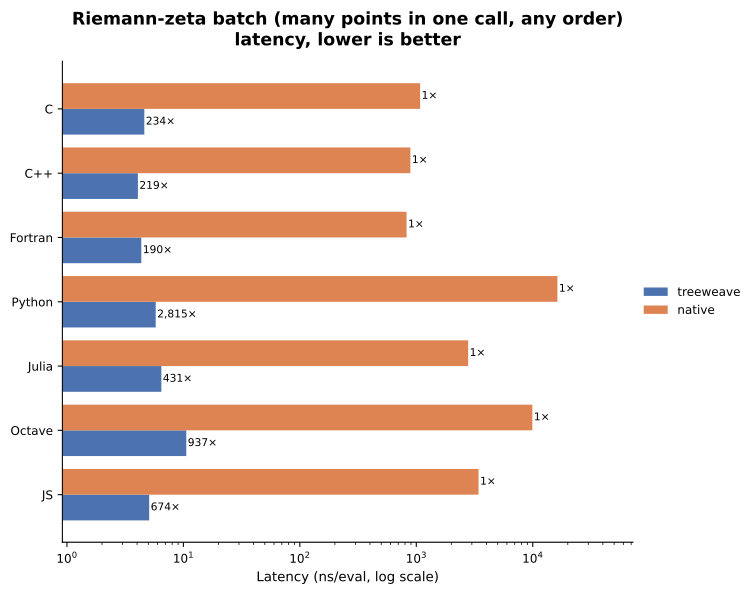
Riemann-zeta sum benchmarked from all 7 bindings against native recomputation.
Bars: Mevals/s (log scale); labels: within-language speedup.
Cross-language Mevals/s is not comparable, because the CI runners differ.
Compare each language’s treeweave bar to its own native bar.
The benchmark-showcase CI matrix regenerates these charts.
Throughput, Mevals/s, higher is better
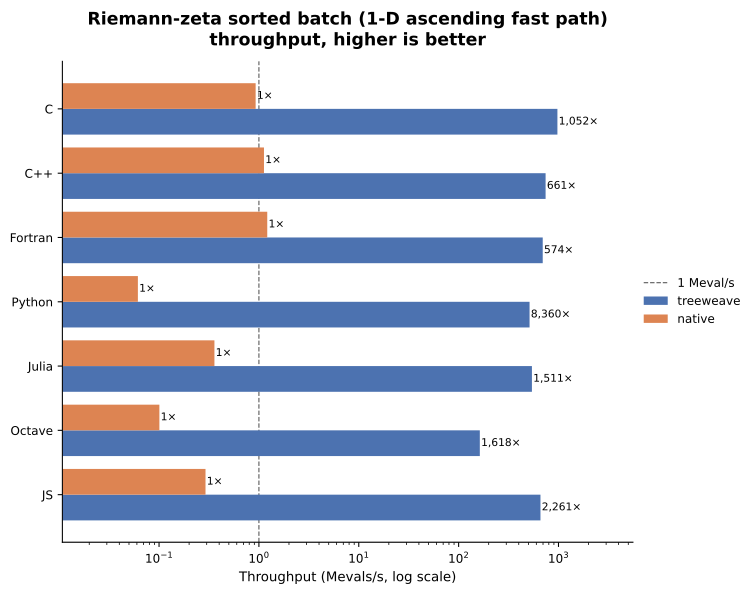
Latency, ns/eval, lower is better
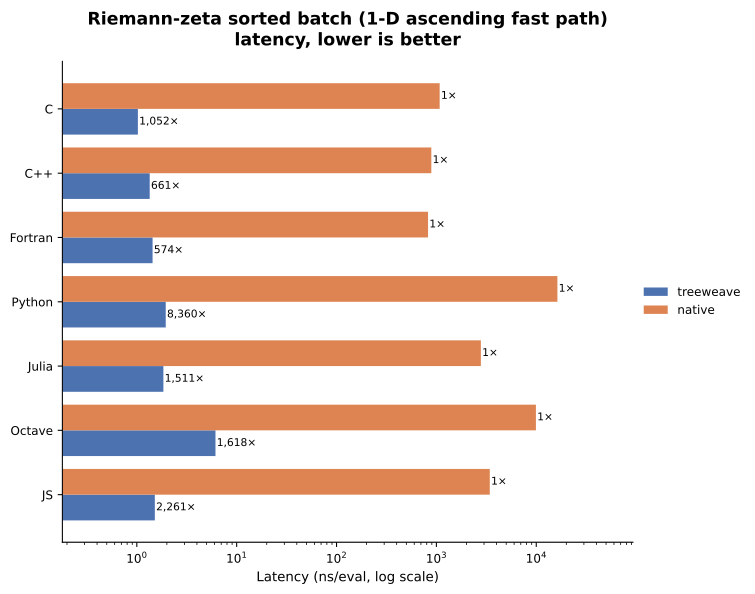
Batch vs sorted batch