Comparison with native interpolators
Most languages already have interpolators: Chebyshev series (numpy
Chebyshev, FastChebInterp.jl, Boost.Math, GSL), splines (SciPy, Boost.Math,
GSL, Interpolations.jl, spline and pchip in MATLAB/Octave) and linear lookup
tables (numpy.interp, interp1). This page compares treeweave with each of
them on one problem, at one accuracy. It also
compares treeweave with baobzi,
the library that inspired treeweave.
The problem
The target is the Riemann zeta function as a fixed 160-term sum on [2, 10]:
A direct sum costs up to 160 pow calls per point, about 1 Mevals/s in C++. A
code that calls it a million times per step spends its time in this sum. The
usual fix is to fit an interpolant once and evaluate the interpolant.
The rules
Every method fits the same function on the same interval.
Every method grows until it meets
max|p - f| <= 1e-10 * max|f|, the default criterion of treeweave (RelativeMax). Chebyshev methods grow the degree, splines and lookup tables double the number of uniform knots from 16, and Boostchebyshev_transformand baobzi tighten their own tolerance.The benchmark times each method only after the method meets the tolerance.
All error values come from the same 4096 random points.
baobzi gets the order (6 to 16) and tolerance that give its fastest batch.
Each method uses its native call: a scalar call per point for “single”, and one vectorized call for “batch” and “sorted batch”.
Results
One CI run of benchmark-showcase.yml on ubuntu-24.04, 2026-11-12
(run 43301633038).
The unit is Mevals/s (higher is better). The number in parentheses is the
treeweave throughput divided by the throughput of that method. The
README has the numbers
of the latest run.
Language |
Method |
Size |
Single |
Batch |
Sorted batch |
|---|---|---|---|---|---|
C |
treeweave |
tol 1e-10 |
56.5 |
195 |
929 |
C |
GSL |
degree 26 |
24.7 (2.3×) |
24.6 (7.9×) |
24.7 (38×) |
C |
GSL cubic spline |
32768 knots |
8.5 (6.6×) |
8.5 (23×) |
89.4 (10×) |
C |
GSL linear |
524288 knots |
4.1 (14×) |
4.1 (48×) |
50.4 (18×) |
C |
baobzi |
order 10, tol 1e-08 |
49.5 (1.1×) |
55.4 (3.5×) |
143 (6.5×) |
C++ |
treeweave |
tol 1e-10 |
270 |
246 |
1,144 |
C++ |
Boost.Math |
degree 27 |
27.2 (9.9×) |
27.7 (8.9×) |
34.6 (33×) |
C++ |
Boost.Math cubic B-spline |
1024 knots |
85.2 (3.2×) |
85.2 (2.9×) |
85.2 (13×) |
C++ |
Boost.Math quintic B-spline |
512 knots |
14.2 (19×) |
14.3 (17×) |
14.3 (80×) |
Python |
treeweave |
tol 1e-10 |
1.2 |
295 |
1,654 |
Python |
numpy |
degree 26 |
0.2 (6.8×) |
30.9 (9.5×) |
24.1 (69×) |
Python |
SciPy |
2048 knots |
0.2 (5.8×) |
14.6 (20×) |
172 (9.6×) |
Python |
SciPy |
512 knots |
0.3 (4.4×) |
8.0 (37×) |
14.6 (114×) |
Python |
|
524288 knots |
0.8 (1.4×) |
5.3 (56×) |
118 (14×) |
Julia |
treeweave |
tol 1e-10 |
42.2 |
313 |
883 |
Julia |
FastChebInterp.jl |
degree 26 |
57.4 (0.74×) |
64.2 (4.9×) |
65.1 (14×) |
Julia |
Interpolations.jl cubic |
32768 knots |
101 (0.42×) |
102 (3.1×) |
101 (8.7×) |
Julia |
Interpolations.jl linear |
524288 knots |
85.8 (0.49×) |
314 (1×) |
396 (2.2×) |
Octave |
treeweave |
tol 1e-10 |
1e-03 |
110 |
214 |
Octave |
|
2048 knots |
4e-03 (0.39×) |
8.0 (14×) |
20.6 (10×) |
Octave |
|
8192 knots |
3e-03 (0.5×) |
7.6 (14×) |
20.6 (10×) |
Octave |
|
524288 knots |
2e-04 (8.8×) |
4.7 (24×) |
23.9 (9.0×) |
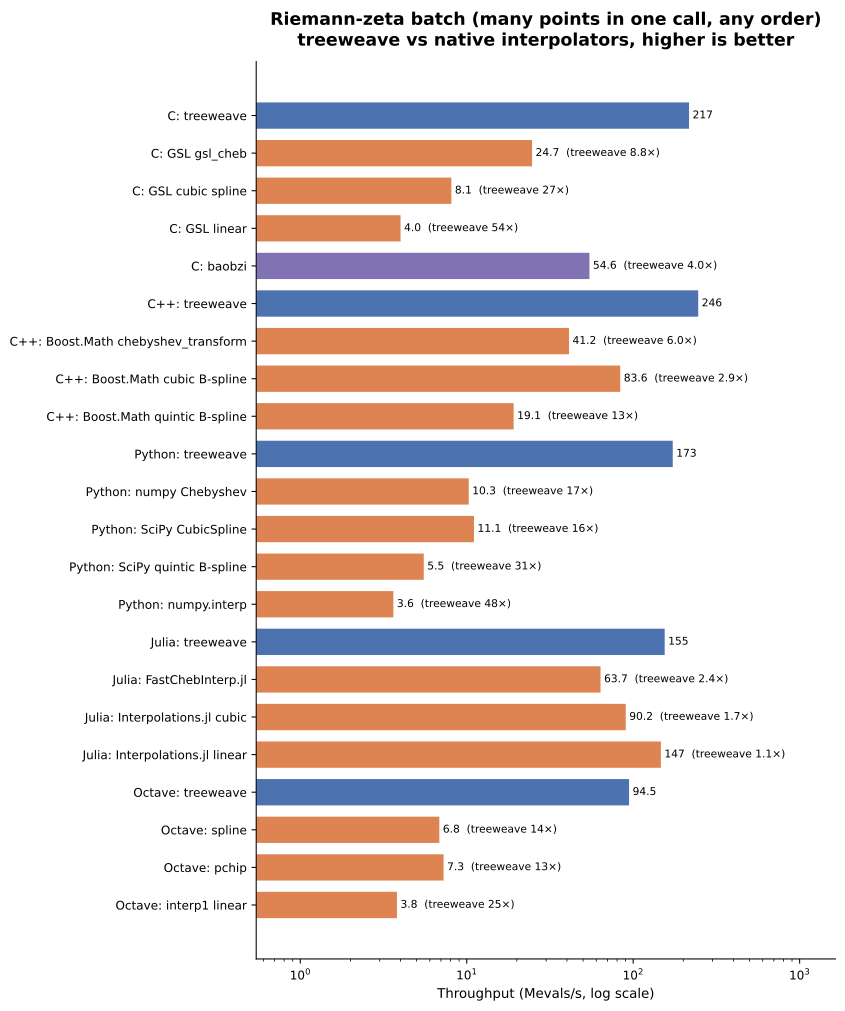
Why treeweave is faster
A global Chebyshev series needs degree 26 or 27 to reach 1e-10 on this interval.
Each evaluation is a Clenshaw recurrence of 26 dependent steps. treeweave
splits the interval into leaves and fits a polynomial with 6 coefficients on
each leaf. Each evaluation is a leaf lookup and 6 fused multiply-adds: 5 in
Horner form and 1 for the domain map.
Splines and lookup tables reach 1e-10 only with 512 to 524,288 knots. Each
evaluation first finds the interval of the point. GSL, numpy.interp and
interp1 do a binary search over the knots. For an unsorted point in a
524,288-knot table, this search reads an array of 4 MiB, which is larger than
the L2 cache. Interpolations.jl calculates the interval from the uniform
spacing, without a search.
The batch call evaluates many points at once with SIMD. The sorted batch call also skips the internal sort, so consecutive points stay in the same leaf. The performance guide gives the details.
Where treeweave is not faster
Single-point calls from Julia and Octave. Each call crosses a C binding, and this crossing costs more than the polynomial evaluation. The Julia interpolators are native Julia code, so the Julia compiler inlines them (0.42× to 0.74× in this run). Octave
splineandpchipalso evaluate one point faster than treeweave (0.39× and 0.5×). Use the batch call from these languages.Lookup tables in Julia. Interpolations.jl linear on 524,288 knots has the same batch throughput as treeweave (314 and 313 Mevals/s), because it does not search for the interval. On sorted batches treeweave is 2.2× faster.
Error. The baselines stop below the tolerance (3.2e-12 to 8.3e-11 relative to
max|f|, 4.5e-11 for baobzi), and treeweave stops at 9.8e-11 to 9.95e-11. All of them meet1e-10.One run per method after one warm-up, on a shared CI runner. Read the ratios to the nearest factor of two. The number of knots can change between runs, because the 4096 check points are random.
Reproduce
Configure with TREEWEAVE_BENCH_BASELINES=ON to build the C and C++
baselines. This option needs Boost, FFTW, GSL and baobzi.
cmake -S . -B build/bench -G Ninja -DCMAKE_BUILD_TYPE=Release \
  -DTREEWEAVE_BUILD_TESTS=OFF -DTREEWEAVE_BUILD_BENCHMARKS=ON \
  -DTREEWEAVE_BENCH_BASELINES=ON -DCMAKE_PREFIX_PATH=/path/to/baobzi-install
cmake --build build/bench --target zeta_bench treeweave_c_zeta_bench
build/bench/zeta_bench
build/bench/treeweave_c_zeta_bench
The Python, Julia and Octave benchmarks are in
bindings/python/benchmarks/zeta_bench.py,
bindings/julia/Treeweave/benchmarks/zeta_bench.jl and
bindings/matlab/benchmarks/zeta_bench.m. The Python benchmark needs SciPy.
The Julia benchmark needs FastChebInterp.jl and Interpolations.jl. The workflow
.github/workflows/benchmark-showcase.yml runs all of them.